When observing the evolution of football tactics , there is always a constant shift from one philosophy to another.
The unpredictability of the WN formation made for some beautiful offensive football in the 1950s. Before meeting its match its match, with the rise of the extremely defensive mentality of the Catenacho in the 1960s,the focus shifted once again in the 70s with Dutch Total Football, that was able to easily exploit these spaces left by these outdated systems ,however as teams grew wary of these intricate movements ,it in turn led the development of zonal marking with managers such as Arrigo Sacchi taking AC Milan to new highs in the 1980s, ensuring that dangerous spaces were covered , meaning all these fancy rotations couldn't easily create gaps .
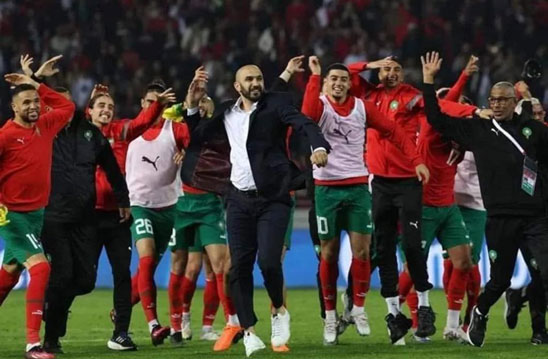
The constant back and forth from offensive to defensive tactics has shaped football for all its existance and there's a reason to believe we might be at a *Tipping Point* in the next few years. The past decate has been dominated by possession football with managers such as Pep Guardiola being regarded as one of the greatest ever with heavy inspiration on Cruyff's Total football , taking it to new levels with constant possession and intricate passing moves to disrupt the opposition , but if the Qtar World Cup has shown us anything , it's that a well organized defensive system can make any team incredibly dangerous and there is no better example than REgragui's Morocco.
Morocco may not have made the World Cup final but their run into the semi final was nothing short end of spectacular , knocking out Belgium ,Spain and Portugal ,before putting up an incredibly entertaining display against France. But what's important to know is that they made it this far by concending only one goal and with an average of possession of only 32% , the second lowest in the whole World Cup . how can a team that never has the ball be so dangerous and what does this tell us about how tactics could be shifting?
To understand how Morocco play , it is important to understand how they defend. Their starting formation is 4-3-3 , however, the team rarely resembles this shape and the vast majority of the time is spent in a 4--1-4-1 in their own defensive half giving the modern offensive playstyle of occupying dangerous spaces with loosely fixed positions . Morocco's answer to this was to not allow teams to move the ball into these positions areas such as the half spaces were difficult to penetrate giving the extremely tight lines , meaning any player in this position could instantly be surrounded ,the central area in front of the defense was excellently patrolled by Fiorentina's Amrabet , constantly shifting from side to side , bonxing an opponent and linking defense with midfield. While being tight between the lines , Morocco were very narrow leaving space out wide which in their way of luring the opposition into a trap, but not only were these spaces in front of the defense incredibly difficult to penetrate , Morocco made even the first pass for opposition as difficult as possible,, Sivilla Striker Youssef En-nesyri wouldn't man-mark the oppositions holding midfielder but would constantly shift ensure the center backs couldn't easily pass the ball forward and if by chance they were able to move it forward , the two midlfielders were always correctly positioned to force a pass backward. This structure would force the opposition to immidiatly play the ball out wide or attempt harder to execute plays such as long switches in play . But all this did was play into Morocco's favor with the team having their most dynamic and agressive players ,and Zyiach and Hakimi on the right and Mazraoui and Boufal on the left , ready to close down the opposition , and if winning the ball back had the pace and technical ability to instantly create dangerous counter attacks. Eventually , this structure would lead to the opposition just constantly circling possession around the back line waiting for a gap to open up ,however, the gap would rarely come. It's also important to note that while Morocco certainly played with a defensive first mentality, it was far from what is commonly referred to as * PPARKING THE BUS*. The defensive line wasn't too deep and the midfield was quick to close any player in the center. In the quarter final , Portugal would often to shift into a 3-2 build up pattern .With Morocco's midfielders adapting to this change and man-marking the double pivot, again forcing play out wide, giving this compact central block , it often meant the opposition would struggle to get their key players on the ball leading to a rather interesting effect.
Let's take their quarter final clash as an example , Portugal's main playstyle involved getting their creative players such as Bruno Fernandez and Bernardo, on the ball between the lines , forcing the opposition's defenders to make a choice and eventually trying to free up space for Felix, Ramos or Dalot on the the overlap, however their inability to do so giving Morocco's defensive discipline let to trusytation for the midfielders who are used to setting to tempo for their own team and in an more useful would find themselves dropping deeper and deeper to receive the ball from the center backs . At times ending up with five players behind the ball . While this is a good way of getting key players on the ball ,it completely limits a team's attacking power as now they can't easily outnumber the defense , meaning that Morocco don't have to make a choice on which space to cover . This also result in the opposition being completely disjoined resorting to long balls over midfield hoping to win any knockdowns again playing into into Morocco's favor, as now , they have the space to attack forward and pick out their moves to dangerous players.
The clash of now vs old was at its peak in the last 16 match with Spain ,with Morocco winning the game on penalties. The 2010 World Champion's ended the game with 76.8 % possession and twice the amount of shots compared to Morocco , but the quality of the chances tells a lot and throughout the game , Spain averaged an XG of only 0.5 comparend to Morocco's 0.4, showing Morocco's ability to limit the opposition's chances to a few pot shots from low risk areas . The semi final agaisnt France allowed us to see a different side to Morocco , as they found themselves one nil down early on in the match and were forced to play more aggressive offensive football compared to what we were used to seeing .And while they weren't able to find the net ,Morocco were able to put France on the back foot for long periods of the match and played some quick beautiful entertaining football that we were yet to witness. Eventually , the individual quality on display proved too much for the first African semi-finalist, but Morocco have certainly left marks on football tactics .
While modern offenssive minded managers have been largely inspired by tactics developed in the 50s and 70s, Morocco and REgragui have proven the same can be applied to defensive tactics, taking elements from Catenaccio in the 60s and *zonal marking* from the 80s to create a modern *Twist* on the defensive block , sprinkled in with some trending tactics such as a *high defensive line and offensive minded* fullbacks .
While they may not have won the World Cup, Morocco certainly entertained everyone watched them play and there's reason to believe that could spark a new rend in football tactics , showing how any well organized team can put even the best footballing nations in tricky situations.
Ali AMADGHOUS
Football Manager