
Bayern Munich will soon win their ninth Bundesliga in a row. It is not a surprise since the 2000/2001 season , Bayern have been German champions 14 times . In the Gundesliga's entire history, which dates back to 1963n they've won on 29 occasions, whith no other club managing more than 5. So , why is German football dominated by just one club and why has Bayern's grip on the Bundesliga only got stronger?
Bayern monopoly isn't reflected in their silverware. They have made 9 of the 10 most expensive signings ever completed by German clubs, and their colours have also been worn by nearly every great German player. In a startling sequence, every World Cup Final since 1982 has featured at least one Bayern Munich player. How do they do this ? It is a combination of factors but - as always- money is extremely important.Bayern have a lot of more of it than their rivals. In the 2021 edition of the Deloitte Money list , their annual revenue was calculated to be 634 M EUR, which was third behid Barcelona and Real Madrid. By contrast , Borussia Dortmund placed just 12th on the list , with revenue of 365 M EUR, Schalke ( 222.8 M) and Eintracht Frankfurt ( 174 M ) were only enough for the TOP-20, and one other - Borussia Monchengladbach (167.9 M) snuck into the top-30 with a revenue equivalent to Premier League in Minnows Crystal Palace.
Success breeds success , but a compounding factor in this inequality is the way the Bundesliga's broadcasting contract has traditionally been shared. A new agreement with begin in time for the 2020/2021 season. Within the current deal , however, between the domestic and international rights , only 25% of the latter is distributed on an equal basis,the rest is performance-related.
Clubs earn in accordance with historic performance at home and in Europe, and - to a lesser extent- rewarded for their production of U23 players. The consequence us obvious. For season 20/21, FootballFinance.com projects that Bayern will receive 105.4M EUR in Bundesliga Broadcasting payments while recently promoted Arminia Bielefeld will receive just 34.3 M EUR.
A fortunate situation but Bayern have also earned some of their advantages, both as reward for sporting performance and relative political stability but also for an ambitious unusual among their domestic peers.
Prior to 1998, German clubs were run as non-profit organisations. Following reforms that year, they were then permitted to run their footballing arms as PLCs ( Public Limited Companies ) with the only restriction on private investment being the 50+1 rule, which ensures that overwall control of the club remains in the hands of its members.
Clearly that's also one of the reasons why Bayern are so secure. Nevertheless, the club's football arm only launched as a PLC in 2002 and , since then , growth has been sustainable and the club has remained debt free. Audi, ADIDAS and Allianz are minority stakeholders,each with an 8.33% share, with the other 75% of the club remaining in the hands of its owners. That is a platform from which they have dominated the new commercial era. Betweek 2002 and 2017, the club's revenue grew by 355%. By 2020, Forber estimated them to be the fourth most-valuable football brand in the world behind Manchester United , Barcelona and Real Madrid. While that that progress has plenty to do with footballing success, Bayern's real triumph has been in creating the commercial apparatus to amplify the benifits. It's not unusual in a global sense but is within a German sporting Society which previously saw football as a communal activity and has a natural suspicion for its business leanings.
in 2014, Bayern opened their first International Office , in New York City. Today , they claim in excess of 32m Fans in North America alone, they've also harvested an impressive portfolio of blue(chip American sponsors, such as Beats Electronics, Procter & Gamble and EA Sports.In 2016, they opened offices in Shanghai and , Today, operate three academies in China. And, while many clubs are happy to license their identity for use in Asia, Bayern are more proactive. Rather than simply licensing their identity in the region , they've built a localised infrastructure. Since 2015, they've had a Chinese website and also produced original, Chinese-language content for a national television channel. They also operate an enormously successful tmall store on Alibaba, have in excess of 4.2 M followers on Weibo and , in December2020,were announced as the fastest growing sports club on Douyin, Tiktok's Asian identity.
The cumulative result of this global activity , which also extends into India, has been an explosion of commercial revenue. Bayern reported 159.3 M in 2008/09 and 360.5M in 2019/2020. By contrast , Borussia Dortmund reported total revenues of just 377.1M during the same period. Dortmund's commercial income for 2019/20 was just 150.2 M ,some 210 M EUR less.
But Bayern's sporting philosophy has also accentuated those advantages. In the Bundesliga, they are the only club who aren't forced to sell players against their will. Whereas the Premier League and LALiga have small groups of elite sides who tend not to trade with each other , Bayern rule the Bundesliga entirely alone - They're not only a club that German-born players aspire to play for , they are the only 'destination' club in a league of stepping-stones.
as a result , their domestic transfer policy has not only regularly improved their squad , it has often significantly weakened the sides beneath them . The transfers of Mario Gotze and Robert Lewandowski are recent examples of that process but over the last few decades bayern have taken talent from all over Germany. Mario Gomez, Benjamin Pavard and Joshua Kimmich from Stuttgart, Lucio and Michael Ballack from Bayern Leverkusen, Leon Goretzka and MAnuel from Schalke.
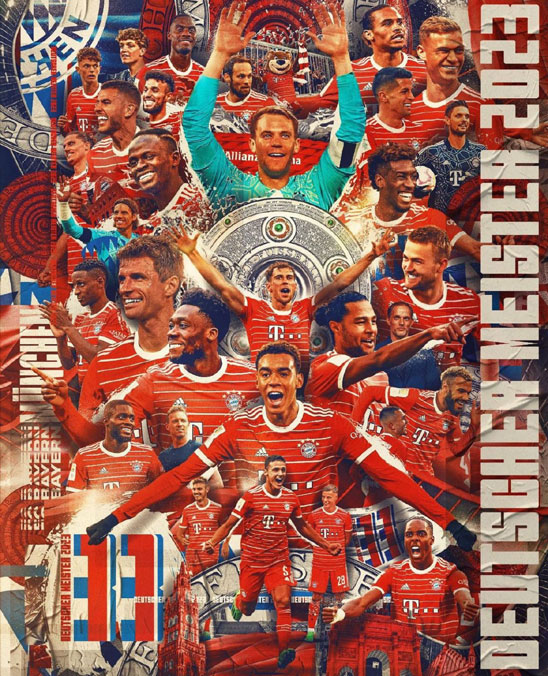
In the summer of 2021, that trend will continue, Dayot Upamecano will move to the Allianz Arena from RB Leipzig. Bayern aren't just predatory .While their transfer record is hardly perfect , they have typically replaced players and refreshed their squad at the right times One of the keys to the current run of consecutive titles, for instance , has been the ability to avoid transitional seasons, either with timely purchases or the development of the right player for a position of need In addition to which the club has continuously employed ex-players in positions of authority, at board level and in the Technical departments. It provides a rich seam of expertise and local knowledge, and it's another explanation for why Bayern are so difficult to compete with - and that would still be the case even if their nearest rivals replicated their political stability or were able to challenge them consistently. Which they're not.
Since 2000, only 4 other clubs have won the Bundesliga , and , of those, Stuttgart have since been relegated twice , Werder Bremen have sunk into mid-table , and Dortmund, for all the recent success, flirted with bankruptcy in 2005 and , in the present day , will soon be forced into the sale of their two best players. As will RB Leipzig, 2020/21's nearly side, who will likely now sell both their centre-halves, one of their most influential midfielders and lose their manager - maybe even to Bayern themselves.
It is a sequence which seems typical .while Bayern Munich continue uninterrupted, the teams capable of challenging them are either emproiled in dysfunction, lacking the resources to be a real threat or caught in a permanent cycle of signings , sales and all of which is to say that : There's little reason why nine titles in a row won't eventually become 10,15 or 20.
Amadghous Ali
Futebol Manager